
Zero install
Works on any browser with WebAuthn. No wallet app to download. No extension. Users never install software to participate.
Self-Sovereign Identity has promised user-controlled digital credentials for over a decade. Adoption remains in single digits even where mandated. The hypothesis behind FIDO4VC is that this isn’t a UX problem — it’s a structural one. On-device wallet apps are the wrong primitive.
FIDO4VC moves the wallet off-device and removes user-side key custody. A wallet still exists; it just lives in a cloud service, cryptographically inert without a live FIDO assertion from the user. The user installs nothing. Recovery comes free from OS Passkey sync. The cloud custodian cannot present a credential without the user — that property is enforced by the cryptosuite, not by trust.
Zero install
Works on any browser with WebAuthn. No wallet app to download. No extension. Users never install software to participate.
OS-level recovery
Signing capability follows the user’s iCloud / Google / Microsoft account across every device. No seed phrase. No vendor-specific backup. Credentials survive device-generation changes.
Cloud-inert credentials
Credentials at rest are meaningless without a fresh FIDO signature. Even with full database access, an attacker cannot present a VP. A property no prior SSI design has.
Familiar UX
Face ID / Touch ID / security key. The exact prompt users see dozens of times a day. Zero training cost.
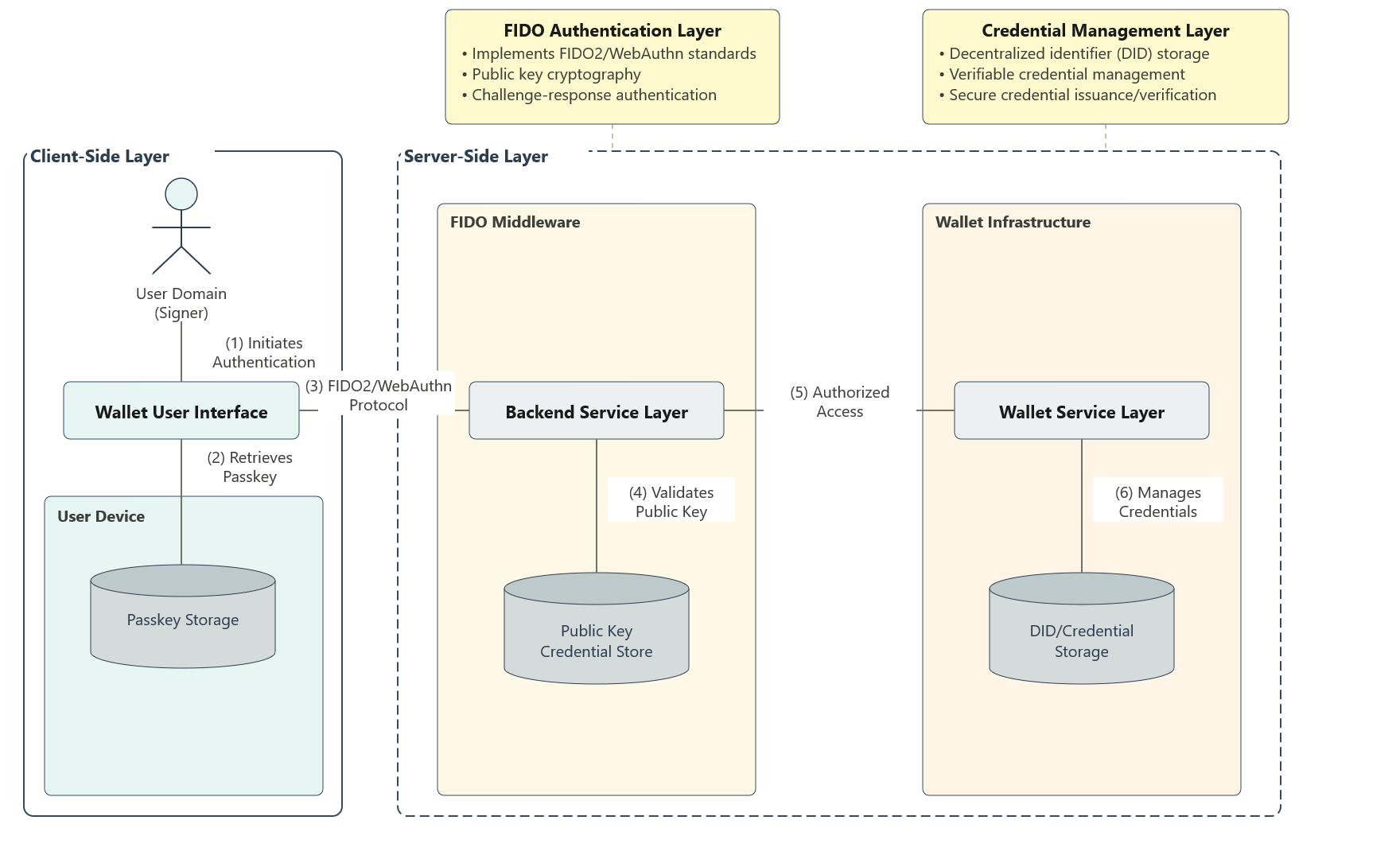
The wallet’s two roles — where credentials live and what signs presentations — are decoupled. Credentials live in a cloud wallet service. Signing authority lives in the user’s FIDO authenticator. Issuance and presentation flows orchestrate the two via standard OpenID4VCI and OpenID4VP, with a new W3C Data Integrity cryptosuite (fido4vc-jcs-2026) gluing the FIDO assertion into the VP proof.
FIDO4VC isn’t a replacement — it slots into the existing identity stack:
DataIntegrityProof shape, with a new cryptosuiteldp_vp proof type with cross-device or same-device flowsVerifiers only need to support one new thing: the fido4vc-jcs-2026 cryptosuite. Everything else is off-the-shelf.